Friday, January 6, 2012

Double-scratching is a winter eating technique

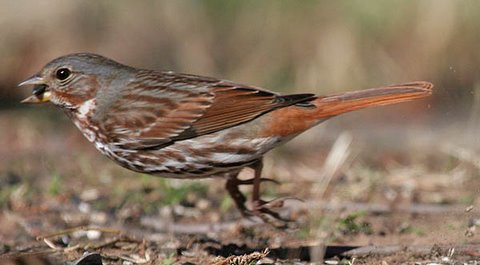
Fox Sparrow
When there is leaf litter on the ground, birds that can (like sparrows, towhees, juncos and most blackbirds) will still search for food successfully. They do it by double-scratching the leaf litter, usually  uncovering tiny insects, eggs or forgotten seed.

Watch closely because it happens fast: The bird hops forward a tiny bit with both legs, then hops backward a little. He may have uncovered food!

Of course, if all the leaf litter has been removed ("the manicured lawn") forget about birds.


Downy Woodpecker

Woodpeckers have many tiny barbs on the end of his (or her) long, narrow tongue. So the tongue has sort of a bottle-brush shape. When the bird sticks his tongue into a suet cake, the barbs catch on the suet and, when bringing the tongue back, break off tiny pieces of it. Several of north Texas' birds peck, but only woodpeckers are adapted like this.

Monday, January 2, 2012

Look closely, it may be a Harris' Sparrow

Harris' Sparrow
Harris' Sparrow
Among the throngs of Juncos in north Texas this winter, there is likely to be a Harris' Sparrow or two. They're the same size as Juncos, they have the same feeding habits and they have similar colors (though in different areas of the body).

Both Harris' Sparrows and Juncos are in the sparrow family, but look closely. While a Junco's back is gray, the Harris' Sparrow back is not. It's finely striped like other native sparrows - tan and white. Nor is its entire head dark gray.


In Texas, astoundingly, NOW is the best time of year to plant native prairie grasses. They don't need fertilizer, They need very little water, and grasses require only once-a-year maintenance. They're also mostly free of pests and diseases.

There are several kinds to choose from, such as Little Bluestem, Indian Grass, Gulf Muhly and Windmill Grass. Just be very sure it's a native prairie grass or it could be a problem.

Thursday, December 29, 2011

Woodpeckers are definitely not killing your tree

Yellow-bellied Sapsucker
Sapsucker
In north Texas, it's the Yellow-bellied Sapsucker that usually gets the blame. But it's just not so - The tree is not healthy!!

The woodpecker (whatever the species) is telling you over and over and over that the tree or shrub is deathly sick.  The tree may look fine to you; but to a bird it's in serious decline. The wood is full of tunneling insects and the tree's sap is abnormally sweet. Both these things attract Sapsuckers and other woodpeckers.

It may be possible to return the tree to health. But it may topple in high wind first.

Eurasian Collared Dove
The Eurasian Collared Dove is becoming accustomed to the north Texas environment. Priority to the mid-80s, however, it wasn't even in the area's field guides. It was introduced to the Bahamas in the seventies, and spread out gradually from there.  It is now frequently seen in the southeast, and is expanding its range westward.

Friday, December 23, 2011

Habitat loss means fewer and fewer bats

When bat populations nosedive, it means big trouble ahead for the human population as well. An example is the Cave Myotis, a species of bat that's disappearing at an alarming rate. Other species are declining too.  In the southwest, that's due largely to loss of suitable bat habitat. So what, you say? When bat populations decline, natural pollination of many crops declines too. Also, there's a large upturn in infestation and crop destruction by flying insects.

All this costs us all a lot of money and adds harmful chemicals to our air. After all, a mature bat eats around 5000 flying insects per night. For free!  You can learn more at www.BatWorld.org -  the website for an excellent, non-profit bat rescue place here in north Texas.


You're totally right to be concerned about any disease carried by birds, no matter how rare or improbable the diseases are. True - cold weather slows or stops the trasnsmission of many bird diseases. But not all! Make sure the birds that visit your yard are healthy enough to fight off diseases, and can have the energy it takes to stay warm.  Even now, clean your feeders with a mixture of 90% water and 10% bleach or vinegar.

Sunday, December 18, 2011

We'd rather fly to Hawaii too, however...

If vacationing in Maui, the Bahamas or Cancun isn't in your budget, do something rewarding right now anyway.  Many people in north Texas have created (or are creating) their private "birdscape" in the back yard - a place where they can go (weather-permitting of course) and not worry about e-mails and such. At no cost! Simply watch birds while relaxing in a lounge chair, or...   A "stay-cation".

Each "birdscape" is unique and different. Size is not a big concern at all. In fact, it's often a matter of "tweaking" an existing back yard landscape. What matters most is what you put IN the birdscape. Whatever it is, it should lower your dependency on store-bought birdseed.

This blog may spur some ideas. Also, I'd like to help face-to-face. As many of you may know, I'm a licensed Landscape Architect in Texas, and have consulted on the landscape design of hundreds of homes. I can also email you a list of "birdscape" plants that are native to north Texas. Just e-mail me.  I've personally seen that these plants are attractive, effective and durable in our climate.

The best time to start planning a birdscape in north Texas is NOW, before springtime and crowds loom around the corner.

MERRY CHRISTMAS!

Poinsettias and the season

Poinsettias (however you pronounce it) have been a symbol of the holiday season for many decades. I love them! The brightly colored part of the plant, however, is not the "flower", it's the leaves (or technically the bracts).
In nature, the Poinsettia is a shrub or small tree that grows in Central America - mainly Mexico. The 3 - 6 inch leaves can be red, pale green, cream, pink, light orange or white. Contrary to urban legend, the leaves are only very mildly toxic; to the same degree that acorns are toxic. They only cause harm if someone eats hundreds of them (who would?).

In its native Mexico it is often called "Bent El Consul" or "the Consul's daughter", referring to the former U.S. ambassador Joel Poinsett.

Marbled Godwit
An incredible record has been set by a small, unusual-looking bird - a Godwit - the Bar-tailed species. Scientists recorded a migration flight of 7,257 miles between Alaska and New Zealand - diagonally across the entire Pacific Ocean. It was done without resting along the way, across nothing but water, non-stop. 

Tuesday, December 13, 2011

Exploring squirrels' trickery with burying nuts

Everyone knows that squirrels bury nuts to eat later. However, researchers have discovered that squirrels often play tricks. They'll dig a hole, then NOT bury a nut in the hole. When a squirrel knows that something or someone is watching, and digging up nuts a moment later, he may dig a "fake" hole. This way he could discourage the watcher and get him to give up (maybe a BlueJay or even another squirrel).  A squirrel may even re-bury a nut, in the same or another place, to make it harder to pilfer.


Some common birds sing at a higher pitch when living near a highway, or a similar noise-producer. This way, they can be heard above the low-frequency noise of traffic. If the same bird travels to a quieter, more natural setting, he or she switches back to the customary, low-frequency song.