Wednesday, October 3, 2012

The "sparrow" that's not a true sparrow

As you may have discovered, the House Sparrow is an undesireable little bird, and is not really a "sparrow". It has given the true Sparrows (which arrive here in about a month) a bad name. The House Sparrow (sometimes called an English Sparrow) was originally called a "sparrow" only because it looks somewhat like true sparrows. It is not a native North American bird, beung brought to this country against its will in the late 1800s because of its agressiveness and dominating habits.  House Sparrows are still mean, agressive birds that will kill other birds, take over other's nests or chase them away.

Harris' Sparrow
White-throated Sparrow
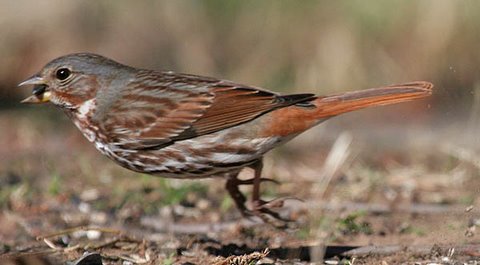
Fox Sparrow
White-crowned Sparrow
Chipping Sparrow
All true sparrows spend the warmer months up north, and migrate to this area only with the advent of cooler weather. (House Sparrows, conversely,  are here all year long).  In north Texas, the true sparrows include Chipping Sparrow, Harris' Sparrow, White-throated Sparrow, Olive Sparrow, Fox Sparrow, Vesper Sparrow, White-crowned Sparrow, Black-Throated Sparrow, Grasshopper Sparrow and Savannah Sparrow. But NOT what's called a "House Sparrow".

Savannah Sparrow
 
It may take centuries of evolution but a common backyard bird in north Texas is gradually learning to outcompete the ubiquitous House Sparrow.   The native House Finch is learning how to get and keep the best nesting sites, the best food, etcetera.

Saturday, September 29, 2012

The upside of fire is that it can be good for birds

Scientists at Cornell Laboratory of Ornithology say that a decrease in birds is linked to, among other things, human's urge to put out all forest fires, right away. Even those fires that don't endanger humans. They cite several situations where forest fires actually led to large increases in bird populations.

Pluses for birds are that forest fires consume dead logs, clearing spaces for new, native vegetation. Fires get rid of competing (and often invasive) vegetation, and cause several tree species to release seeds of new trees. Forest fires (which are predominantly a natural occurrence) add lots of carbon to the soil.  All this allows dense, new vegetation to grow, adding many, many new nesting sites and food sources.


Most birds migrate at night.  At night, the winds are calmer, making flight easier. At night, most predators aren't active, and the temperature is cooler. Most songbirds, however, are normally active during daylight only. So for a short period just prior to and during migratory flight, songbirds' bodies are adjusted naturally - an activity called "nocturnal restlessness".

In north Texas, we may see it as our hummingbirds migrate south for the winter. That's why I advise leaving nectar feeders up through the first week of October.  This helps feed stragglers from up north; and you may see your feeder a lot emptier each morning.
 

Wednesday, September 26, 2012

Dead trees are home to "cavity nesting" birds

A dead tree is somebody's home
The term "cavity nesters" is used for bird species that nest in old, probably-dead, trees. In north Texas that includes Chickadees, Titmice, Wrens and Bluebirds. These arborial homes were, probably, originally made by Woodpeckers, who lived there and raised a family. But all these birds are having a harder and harder time finding homes, because of humans' proclivity for cutting down all dead trees, and trees that just look sick.


                                    A dead tree left in place boosts the number of creatures dramatically. Watch this video.
.


Saturday, September 22, 2012

Why don't birds fall off their perches?

Belted Kingfisher
When birds sleep or rest, they may perch on a branch and remain there, motionless, for a long time. But, even in sleep, they won't lose their grip and fall off.

You see, their legs are not constructed the same as ours. The arrangement of the leg bones, muscles, tendons and feet is roughly opposite of ours, having sort of a ratchet-type operation. When awake, birds can adjust the leg/foot movement, but when asleep the feet clench tightly, like they're glued to the perch. This happens automatically.

Scissor-tailed Flycatcher


All fall migration flights aren't to the south. Actually, most north Texas birds don't migrate at all. The Grey Bat, however, is a tiny harmless creature that flies north. It lives in warm, dark caves, like south Texas and Florida. But when it wants a place to hibernate each winter, it seeks out relatively cooler areas, perhaps Arkansas or Tennessee.

During this wintertime hibernation in cool areas, its heart rate drops from several hundred beats per minute to twenty or thirty.


Wednesday, September 19, 2012

You have bats in your neighborhood. Really!!!

Whether you've seen them or not, it's almost certain that bats are in your neighborhood. Which is a very good thing, despite what old Hollywood fables proclaimed.

Mexican Freetail Bat
One healthy adult bat can catch and eat about 5000 flying insects per night. Pretty good for an animal about an inch-and-half long. We were just in Austin, and visited their urban bat colony; didn't see a single mosquito.

Bats hunt within a radius of about 40 miles. So a bat roosting in your neighborhood could be eating mosquitoes in Gainesville, Frisco, Graham or your back yard.

Actually bats are not rabies vectors. They don't carry rabies without getting very sick themselves. And if they're sick they can't fly or hunt food, and usually die in about a day.  Not much time to bite a human and transmit rabies. There is no plausible evidence of airborne rabies transmission by bats. To the contrary, they eat a lot of insects that do carry disease - like West Nile Virus.

Yes, bats have an image problem. If a colony of bats gets wiped out (for whatever reason) it's slow to repopulate. That's because each female has only one "pup" per year.

Bats like to be near water. That's because one can lose up to half its body weight through evaporation in a day. A dangerously dehydrated bat isn't able to catch many insects - if it's a female, she and her pups may die.

Austin's bats generate roughly $10-million a year. Does your neighborhood or city have a potential place for a bat colony? Bridge, tunnel, old overpass? Now's the time to start planning for next year.


     You may have noticed lots of activity at Hummingbird feeders too!  There's a lot more eating and sharing and a lot less fighting. It's working together toward the common goal of a successful migratory flight around the end of the month.  (maybe humans could learn something from this behavior)

Sunday, September 16, 2012

The only bird here that does a good job of smelling

Turkey Vulture
Almost all birds have a very weak or no sense of smell. The one exception in north Texas is the Turkey Vulture. Through evolution it developed a good sense of smell in order to survive.

Turkey Vulture
The Turkey Vulture's purpose in life is to get rid of carcasses (roadkill, dead animals etc.)    It locates them by smell. Turkey Vultures are so good it that they can locate leaks in natural gas lines (The chemical mercaptan, added to gas, smells similar to rotting flesh). By the way, no kind of vulture has ever been known to attack or kill a healthy animal.


Another evolutionary modification helps it pick apart dead animals. It developed its featherless, macabre-looking, head and neck so it could probe into rotting carcasses without picking up bits of flesh and blood.


 Birds here talk Texan.   In a 'birdy' way.   Identical kinds of birds often sing differently, depending on where they were raised.  For instance a Blue Jay here in north Texas sounds a bit different from one (for instance) from Connecticut.

Wednesday, September 12, 2012

Luckily we have Cardinals almost everywhere now

Northern Cardinals (female, male)
Several decades ago Cardinals were very, very rare in north Texas. In the 1800s the Northern Cardinal (its full name) lived in North America only as far north as southern New York, and west only to wooded portions of the Great Plains.

Times change!!   In the 21st Century, the Cardinal is almost everywhere in this country (except chunks west of the Rocky Mountains). This is largely due to their adaptability, and the large number of people who feed birds and provide habitat (you're probably one), so Cardinals can survive hot summers and freezing winters. Today their range extends into southern Canada, and from the Rockies east to the Atlantic coast. And north Texas!

Cardinals live naturally only in forest edges. However, as man cleared millions of small areas for homesites, more and more 'forest edge' was created. We even grew and stored lots of Cardinal-food such as corn and wheat.

Cardinals are easy to attract to your yard. All you'll need are well-stocked feeders and the appropriate habitat - some dense vegetation including trees. Adult Cardinals will escort their fledglings to the vicinity of a birdfeeder. Then the parents will bring seeds to the fledglings from the feeder. The fledglings soon catch on, and will visit the feeders themselves. This "teaching  by example" often happens at backyard birdbaths too - throughout the year.

Black oil sunflower seeds are their favorite, but they'll often eat other seeds. They actually like suet too, especially if it contains sunflower seeds.