Thursday, October 20, 2011

Are there enough dead trees in north Texas?

For birds to protect themselves from bad weather, and to raise little birds, there needs to be at least four dead, full-size trees per acre, according to 'Bird Watchers Digest'. Clearly, they make nests in them, or on the branches.  If all dead trees are totally removed, birds will simply go elsewhere.

Thirty to forty percent of all birds in north Texas nest in the "cavities" in dead trees. To keep those birds around my yard, when I remove a dead tree, I often leave a tall stump (6 ft or more).

Does your neighborhood make Chickadees, Wrens, Woodpeckers, Titmice, Bluebirds and Swallows feel at home?


Since thousands and thousands of bats, flying closely, don't ever bump into each other, we know that they're not blind. That's a total myth!

They each use an exceptionally fast and accurate sonar-like system called "echolocation" to avoid other bats, to avoid humans, and to find food (flying insects). Each bat makes an extremely high-frequncy sound and listens for the sound to bounce off an object. This happens in a millisecond.

Each bat has a slightly different sound so they don't interfere with each other. They can also use this unique sound to identify family members.
bats hunting at dusk, Uvalde TX

Monday, October 17, 2011

An owl's grasp is lethal to its prey, by design

Barn Owl


Great-horned Owl

An owl can grasp its prey with deadly effectiveness; anything from a field mouse to a squirrel.  They have razor-sharp talons which dig into the victim, puncturing whatever organ may be in its path. Also, all owls have outside "toes" that pivot forward and backward, making it adept at conforming its lethal grasp to the exact size of the prey.

Here in north Texas, frequently-present owls are the Great-horned, Barn, Screech and Barred.


Downy Woodpecker

Woodpeckers frequently hammer on a house's siding; often it's the Downy Woodpecker. If the siding's metal, or he's hammering on metal flashing, it can be annoyingly loud. He's sometimes looking for insects; but he's discovered that his hammering can be heard for great distances, by other woodpeckers. It tells other males to stay out of "his" territory.
Downy Woodpecker

Thursday, October 13, 2011

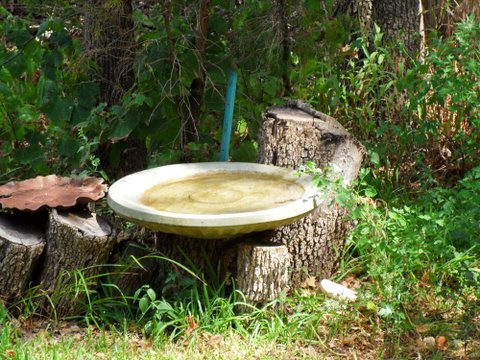
Don't put away your birdbath unless it's cheaply made

Starting about now, a few people will put their birdbaths away (in the garage?). They're afraid that freezing weather in the future will cause cracks in a concrete birdbath. And they're right; if the birdbath is made of cheap, poorly-mixed concrete.

If the birdbath is made of good, well-made concrete it shouldn't crack in cold weather. Which is precisely when north Texas' birds need birdbaths the most!


Red-bellied Woodpecker
It may look like it but a woodpecker doesn't really walk up a tree trunk - it hops up the trunk using both feet at the same time. So for a fraction of a second it's completely airborne. If you look carefully, you can see this. (The woodpeckers we're likely to see in north Texas all year long are the Downy Woodpecker, Hairy Woodpecker and Red-bellied Woodpecker. Additionally, in cold weather we're likely to see the Yellow-bellied Sapsucker and Northern Flicker).
Downy Woodpecker

Hairy Woodpecker


A reader of this blog spotted a Catbird at her birdbath;  just northeast of Denton. Keep your eyes peeled and let me know of any special sightings!
Catbird

Sunday, October 9, 2011

Brown leaves probably don't mean the plant's dead.

I really doubt that this native plant is dead; next spring it'll be green and healthy
 
A plant with shrivelled, brown leaves, or no leaves at all, may not really be dead.  Cutting it down or pulling it up may be a mistake.

Clearly we've endured a hot, dry summer. Some plants are looking like they're through with this world. But north Texas has had many, many hot, dry summers in the past;  this summer was nothing new. Native plants have learned how to adapt.

A very common adaptation is dormancy. Many native trees and shrubs go dormant when under severe stress - looking like they would in the winter. Next spring they'll probably put out new, green leaves as if nothing had happened. Just like they have for many centuries!  (Of course if a plant stays dormant too long, if the soil's bad or for some other environmental reasons, it'll really die.) 

In the meantime I suggest you keep taking care of "brown-leaf trees" as if they looked healthy: which for native plants means doing hardly anything. Actually, giving them a lot of extra water during dormancy may, in fact, kill them.


The Blue Jay we see throughout north Texas is thought of
as a bird that doesn't migrate. Which is true much of the time. A few flocks, however, are what are called "partial migrators". They don't migrate to South America - they'll just relocate a hundred miles or so. They'll sometimes move to a slightly warmer area with more abundant food - maybe just to the adjacent county or merely down a mountainside, into a valley. One place these "partial migrators" may move is into urban areas, since the 'heat island' effect makes it a few degrees warmer. It's just one of the birds that contributes to north Texas having more birds in cool weather, than in the summer. Even if they stay put, like most of them do, there are plenty of Blue Jays in north Texas in both January and July.

Thursday, October 6, 2011

Save by making your own suet & Home-buying criteria


Assuming you have the time and the patience, here's a suet recipe that might save you some money, or be a good scout project, or whatever;
             1 cup of shortening
             1 cup of crunchy peanut butter
             1 cup of flour
             2 cups of old-fashioned corn meal
             half-cup of sugar
             2 cups of fresh birdseed (the birdseed can be almost any type. I recommend straight, 100% black-oil sunflower.   A "hull-less" seed will not work.)

Melt the shortening and the peanut butter over medium-high heat in a skillet (preferably iron). Then add the dry ingredients and mix well. As the mixture cools, press it into shape (or cut it) to fit your suet feeder. Most feeders take suet that's slightly larger than a slice of bread.

Let the formed suet cool in your refrigerator for at least an hour before putting it into your feeder.

Woodpeckers on a suet stick


Things change!!!  It used to be swimming pools and big garages. But a 2010 survey by the National Association of Realtors showed a big, new trend.  88% of buyers said that environmentally-friendly features were important considerations when purchasing a home. Such things as low-maintenance landscaping, programmable thermostats and sustainable construction methods are now important to buyers.
save trees by maintaining natural grade
reduce edging by grouping taller plants

Thursday, September 29, 2011

Attract birds for hardly any money;

You can attract birds and butterflies to your yard for less than you're shelling out now. Maybe for next to nothing!  (NOTE: some of these ideas may not be appropriate in other parts of the country, but they all are valid in north Texas)

By far the most effective thing you can do is reduce the size of your grassed lawn. Shrink it down to what you actually need - not what somebody else thinks you should have. At our place, roughly one-quarter of our yard is lawn (grass). That's all we need and all we need to maintain (I have better things to do). The rest is "birdscape".

To a bird, a big grassy lawn is like a desert; with almost nothing to eat, no water and no place to hide, rest or nest. This time of year (unlike up north) is easily the best time to plant trees and shrubs. Less lawn translates into more places to plant these birdscape plants.
In a birdscaped yard, native Texas plants supply food that attracts birds naturally.  Meaning you need to buy less birdseed! Plants also supply places for birds to find shade, nest, and hide from predators - so they hang around a lot more.
Birds love suet, but regularly buying it takes money.  We also feed suet to birds because it's good for them.  But when we're out we give them the next best thing.  We put some chunky peanut butter on some old slices of bread (usually the 'heels') and put it in the suet cage. As long as you don't do it all the time, it won't  affect their health.

All birds need water every day, whether the weather's freezing or super-hot. Water (like in a birdbath) is not only inexpensive, but will attract species that don't eat seeds, such as Robins, Wrens, Mockingbirds and Flickers. A "birdbath" needn't be an expensive, ornate thing - anything that holds water and doesn't embarrass you is fine.

Another inexpensive thing is a "brushpile". It's just what its name implies - a random pile of woody branches (tree trimmings?), leaving lots of nooks and crannies inside for birds to find. Every yard can and should have a brushpile; it's a mini bird sanctuary.

Feeding only good, fresh seed is crucial. If you run out, so be it. The birds can simply eat something in your birdscaped yard. If you ever use cheap/stale, grocery store or big box seed, however, the birds will leave that feeder for good! A wild bird gets only about 10% of its food from birdfeeders. So remember - just because a feeder is empty, it doesn't mean you have to fill it.

A feeder that goes empty for several days is like a restaurant closing - the birds won't starve; they'll just go somewhere else. And if your yard is birdscaped, they'll still be in your yard.  

Sunday, September 25, 2011

They'll migrate no matter what we do

A few people still think that a full birdfeeder (or nectar feeder) will prevent birds from migrating and somehow "trap" them here for the winter. That's not only been disproven - it's also silly.

The one and only thing that triggers migration (as it has since well before mankind walked erect) is photoperiodism - the relative amounts of daylight and darkness over time.  Food availability and weather have nothing to do with when they leave north Texas. These two factors only determine the pace at which birds migrate.

Photoperiodism, usually called 'day length', also triggers leaves to grow or fall, flowers to bloom or go to seed, animals to hibernate, insects to become active, wild animals to have babies, and so on.  It's been this way millions of years before Man appeared on earth.

So when your neighbor takes credit for causing flowers to bloom since he added a certain chemical to the soil, or he cautions you to take down birdfeeders  for fear of "trapping" birds for the winter, remember that the earth tilting and revolving on its axis, making days shorter or longer, is the one and only cause.


An example in north Texas is the Robin.  Due to Texas' slightly longer day-length and relatively mild winters, Robins (and several other birds) think of this area as "the South".  So the Robins from up north migrate here for the winter.  And local Robins stay right here. As a result we have more Robins in north Texas in the winter than the summer. Thanks mainly to photoperiodism.