Wednesday, October 17, 2012
North Texas birds, water and attracting owls


Sunday, October 14, 2012
Foreign birdwatchers want to see WHAT while here??
 |
| Blue Jay |
Blue Jays are throughout north Texas, and as Texans know, Blue Jays are particularly fond of acorns (we live in a "post oak savanna). This fondness is mostly responsible for the rapid spread of oak trees after the last ice age. They are able to hold several acorns at once, while flying.
 |
| Blue Jays |
Do north Texas woodpeckers migrate? Some do -- some don't. Muddy answer I know (but true). Of the 22 woodpecker species north of Mexico, only 15 migrate long distances.The others don't migrate at all, or are "partial migrators" - just moving into a nearby valley, or something like that. Non-migrators include the Downy and Hairy Woodpeckers, and the Red-bellied Woodpecker. On the other hand, our local species of Yellow-bellied Sapsucker (a member of the woodpecker family) spends summers and breeds up north and migrates here for the winters.
Wednesday, October 10, 2012
Save lots of money on fall lawn feeding by doing it naturally

For many, many years I've not fed my lawn with stuff from a bag, and my grass is doing quite well. I'm no chemist or botanist, but the results speak well for feeding your lawn naturally in the fall. The health of my lawn, and of my clients' lawns, attest to it.
For years I've mowed my lawn, leaves and all, a couple of times each winter. Basically, this shreds the dead, fallen leaves into tiny pieces (about the size of a dime), which decompose more rapidly into organic matter and add a lot a carbon and other nutrients back into your soil. An added advantage is that the decomposing matter will attract birds like crazy; to pick through the leaf-bits in search of food.
In a very short time the tiny pieces of decomposing leaves will disappear from view, as they filter down between the blades of grass and become part of the soil. This replicates the process that happens naturally in a forest; but does it in a lot less time. This eliminates a lot of leaf-raking too.
(if you're worried about "thatch" - don't be. Thatch, a very rare occurrence, is almost always a fable told by people who want to sell you something)
Sunday, October 7, 2012
Listen for north Texas' most common owl.
 |
| Screech Owls |
Listen carefully, and you may hear the call of north Texas' most common owl - the Eastern Screech Owl. If it's nightime, and you're in or near woods, listen for a tremulous horse whinney sound. Some call it a "screech", and others speculate it's the sound of heard by the rider in Washington Irving's tale, "Headless Horseman". Whatever it sounds like, it's not the "hoot-hoot" so often associated with owls.
 |
| Eastern Screech Owl |
Other owls common here in north Texas are the Barn Owl and the Barred Owl.
You and your kids can look for bats when they're flying around - in the dark of night hunting bugs (The tiny animals are harmless to humans). Simply fasten a
piece of tracing paper over a normal flashlight lens. The light will then be dim enough to not be seen as troublesome to bats. Bats will still be able to detect tiny objects, very accurately, in the dark. And you'll be able to see them.
Wednesday, October 3, 2012
The "sparrow" that's not a true sparrow
As you may have discovered, the House Sparrow is an undesireable little bird, and is not really a "sparrow". It has given the true Sparrows (which arrive here in about a month) a bad name. The House Sparrow (sometimes called an English Sparrow) was originally called a "sparrow" only because it looks somewhat like true sparrows. It is not a native North American bird, beung brought to this country against its will in the late 1800s because of its agressiveness and dominating habits. House Sparrows are still mean, agressive birds that will kill other birds, take over other's nests or chase them away.
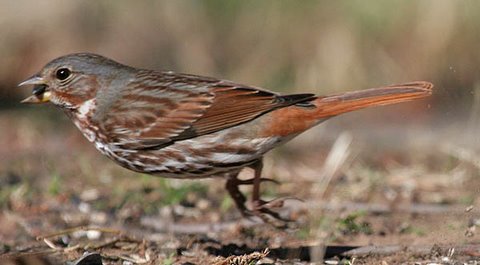
All true sparrows spend the warmer months up north, and migrate to this area only with the advent of cooler weather. (House Sparrows, conversely, are here all year long). In north Texas, the true sparrows include Chipping Sparrow, Harris' Sparrow, White-throated Sparrow, Olive Sparrow, Fox Sparrow, Vesper Sparrow, White-crowned Sparrow, Black-Throated Sparrow, Grasshopper Sparrow and Savannah Sparrow. But NOT what's called a "House Sparrow".
It may take centuries of evolution but a common backyard bird in north Texas is gradually learning to outcompete the ubiquitous House Sparrow. The native House Finch is learning how to get and keep the best nesting sites, the best food, etcetera.
 |
| Harris' Sparrow |
 |
| White-throated Sparrow |
 |
| Fox Sparrow |
 |
| White-crowned Sparrow |
 |
| Chipping Sparrow |
 |
| Savannah Sparrow |
Saturday, September 29, 2012
The upside of fire is that it can be good for birds

Pluses for birds are that forest fires consume dead logs, clearing spaces for new, native vegetation. Fires get rid of competing (and often invasive) vegetation, and cause several tree species to release seeds of new trees. Forest fires (which are predominantly a natural occurrence) add lots of carbon to the soil. All this allows dense, new vegetation to grow, adding many, many new nesting sites and food sources.
Most birds migrate at night. At night, the winds are calmer, making flight easier. At night, most predators aren't active, and the temperature is cooler. Most songbirds, however, are normally active during daylight only. So for a short period just prior to and during migratory flight, songbirds' bodies are adjusted naturally - an activity called "nocturnal restlessness".
In north Texas, we may see it as our hummingbirds migrate south for the winter. That's why I advise leaving nectar feeders up through the first week of October. This helps feed stragglers from up north; and you may see your feeder a lot emptier each morning.
Wednesday, September 26, 2012
Dead trees are home to "cavity nesting" birds
 |
| A dead tree is somebody's home |
The term "cavity nesters" is used for bird species that nest in old, probably-dead, trees. In north Texas that includes Chickadees, Titmice, Wrens and Bluebirds. These arborial homes were, probably, originally made by Woodpeckers, who lived there and raised a family. But all these birds are having a harder and harder time finding homes, because of humans' proclivity for cutting down all dead trees, and trees that just look sick.
A dead tree left in place boosts the number of creatures dramatically. Watch this video.
Subscribe to:
Posts (Atom)