Wednesday, December 12, 2012

Some leaf litter is good for your yard

At this time of year, many homeowners rake up withered plants and fallen leaves out of habit. But nature puts those dead leaves and withered plants there for a very good reason. A moderate amount should stay right where it is. They're a natural source of carbon and other nutrients.

Bare, exposed ground actually encourages “weeds”.  Normal plant debris, left on the ground, becomes an organic humus, resulting in looser soil and giving your soil an ability to hold more water and nutrients, and resist weedy growth. Plant debris also acts like mulch. Water doesn’t evaporate as fast, so your water bill should be lower. Your plants will grow bigger and better. You can buy humus in plastic bags every year, or let it accumulate naturally for free.  It’s your choice.
Please keep in mind that I’m talking about a “normal” amount of plant debris and leaves. If they pile up by an outside wall or on a sidewalk, by all means clean up. (If you own a rake, which I don't)

For years, I’ve shredded excess plant debris into tiny pieces, and put it right back on the landscape, using my lawn mower. Birds, butterflies and small animals utilize this plant debris. Harmless insects do too!  They serve as food (remember the food chain?) for the aforementioned birds as well as encouraging frequent visits by migrating species.
A word of advice:  be sensitive to your neighbors’ preferences. Take some time to explain why your landscape is “natural”, not manicured. Even if they don’t agree with you, they should know that you have a long-term plan. Your landscape won’t be blamed on laziness or neglect. It’s very ecology-minded too. 

Saturday, December 8, 2012

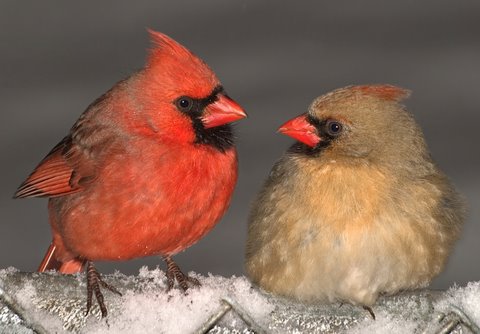
Should I call it a Cardinal, or something else?

Cardinal; juvenile
maybe they're Virginia Redbirds?


We all know what a Cardinal is...or do we?? The Texas Ornithological Society, and most birdwatchers, know it as a Northern Cardinal. But many people (understandably) call it a Redbird (forgetting about the females and juveniles). In Virginia it's a Virginia Redbird or Virginia Nightingale. A few birders call it a Cardinal Redbird. They're all right in a way! Many years ago John James Audubon even knew it as a Cardinal Grosbeak. The only universally-correct name is the cumbersome Latin name Cardinalis cardinalis, but that sounds snobbish.


coyote
                           How dangerous is a Coyote...really? According to Audubon Magazine, there has been only one reported coyote-related death in the U.S. That was over 30 years ago! Typically, Coyotes try hard to avoid people, but we're seeing more and more as we expand into their natural range, and Coyotes have less and less territory in which to hunt.

Those are the facts!  I'm not worried, but if I were a rabbit or housecat I would be.
 

Wednesday, December 5, 2012

Why are birds not visiting my yard right now?

It's absolutely normal. It's nothing you've done, or are not doing. In a week or two it'll be totally different.


Chickadee on sumac
Starting around the end of September and continuing right now, plants are setting seed in dozens and dozens of forms.  You see native grasses producing "plumes", acorns and pecans litter landscapes everywhere, and all our native flowers have "gone to seed". This cornucopia of fresh seed is more enticing to wild birds than anything you could buy in a store. It's as fresh as it can get! So this is where the birds are, not at feeders.

When we get a hard freeze in north Texas (and/or ice storm or snowfall) they'll flock to your feeders enthusiastically. It's important to be ready now, since wild birds will need seed instantly, and won't wait around a day or two - they'll just go to somebody else's feeder.

The leaves on the ground also attract birds, insectivores mainly. The dead leaves harbor millions of tiny bugs. Birds pick through them endlessly for food.

In ensuing years you might want to keep birds in your area by planting what I call "birdscape" plants in your yard.  These plants produce seed reliably and in abundance, and provide totally fresh food for birds throughout the fall. The plants are native to this part of Texas, so the very best time to plant them is now (of course you won't see any top-growth until spring, but the roots will be growing like crazy). I'd be glad to send you a list of these plants if you send me your e-mail address.


[Actually, the above is in response to a question I got recently from a friend.  I thought many of you might have the same worry}

Saturday, December 1, 2012

A simple change in thinking attracts Chickadees to your yard


Chickadee eggs in stump


North Texas' kind of Chickadees (Carolina Chickadee) like to nest in old trees. Right now is not nesting season, but it's a time when lots of trees are taken down. You can remove trees in such a way as to make them inviting for nesting Chickadees in the future (as well as several other native species).

Chickadees really like the exposed inner core of fallen trees. This core is soft and decomposes faster than the rest of the tree. So it makes a slight depression. In nature, this may be result of a windstorm, forest fire or equivalent. In your yard, if you plan on felling a tree, consider leaving a tall stump (4 to 10 feet) to attract Chickadees.


 IT SAYS ITS OWN NAME    The American common name "Chickadee" is "onomotopoetic". It's what the early settlers heard the bird saying, so that's what they called it. It says "chick-a-dee-dee"

There may be one or more "dee"s at the end of a Chickadee's call. Some research says that the number of "dee"s indicates to other birds the proximity of danger, and its nearness.


gggggdrefe


Wednesday, November 28, 2012

Who among us mistakenly killed a bird recently?

      The same sort of thing goes for rubber bands, bread wrapper "twisties", gift ribbons, packing peanuts and the like. Use your head - we share this world.
 

Saturday, November 24, 2012

Boreal birds could visit us again


Red-breasted Nuthatch

A few years ago, north Texas was treated to an influx of Red-breasted Nuthatches. It happens every few years. These were from the vast evergreen forests of Canada and the northern U.S. known as the Boreal Forest, a huge forest that's home to over 300 species of birds, including Nuthatches. You can usually identify them climbing headfirst down tree trunks, probing the bark for bugs.


Nobody knows precisely why some species fly to more southern areas for the winter; and why Nuthatches sometimes winter here, versus (for instance) Arkansas.  But be prepared for more visits from several “boreal” species this coming fall.


Can you breathe and sing at the same time?
Blue-gray Gnatcatcher
Birds can.  Birds sing through a branched organ called a “syrinx”. Each branch can be controlled independently. So birds can produce two different sounds at the same time. Birds also have a specialized breathing system. They can inhale and exhale (perhaps through the syrinx) since they can manipulate air sacs and lungs independently.


Wednesday, November 21, 2012

calling them "buzzards" might be because you watched a lot of old movies


Black Vulture & Turkey Vulture  (not "buzzards")
      In North America, the vulture is purely a scavenger (road kill and such), never killing a healthy, live animal. A similar word grew out of European mythology. The word “buzzard” originated (improperly) from “busart” in French, and “buteo” – a Latin term for a hawk; a large bird which happens to soar like many other birds. The early settlers of this continent (being largely uneducated) knew only the improper term “buzzard” and applied it to any large soaring bird, including the Red-tailed Hawk, Condor and Turkey Vulture (which certainly isn’t a “buzzard”) merely because they scavenged meat. The only true buzzard is a type of hawk native to Europe. However, many Hollywood films imprinted this error onto audiences, and the improper use of “buzzard” persists in everyday speech.

If we didn't have Vultures around we'd be up to our ankles in roadkill. To my way of thinking, calling these birds "buzzards" is an insult to these gracefully-flying and necessary birds.