Wednesday, December 26, 2012

Squirrels v. your birdfeeders

A hungry squirrel is an athletic squirrel.  It can leap about 8 feet horizontally - from standing still on a nearby branch or roof. Also a squirrel can jump about 4.5 feet vertically - possibly from the ground to a birdfeeder.  So merely hanging a typical birdfeeder from any old tree branch is often asking for trouble.

no seed for you!
There are two reasonable solutions that don't involve traps, firearms or hanging a feeder from a far-away branch.  1.  Fill a feeder with safflower. Most birds like it, but squirrels hate it. One taste of safflower seed and that particular squirrel won't be a problem any more.  2.  Use a squirrel-proof feeder; I suggest a Squirrel-Buster by Brome (pictured). Several feeders claim to be squirrel proof, but the Squirrel-Buster is the only one I know of that actually is. It costs a bit extra, but you'll save the extra cost in a year or two.
We have two at our house. They try, but no squirrel has ever gotten a single seed from them.

A few desperate friends of mine trap them and relocate them. When the "removed" squirrel is gone, however, several nearby ones will fight noisily over the now-vacant territory (a huge headache). The original squirrel usually finds its way back, anyway.

We use the other method too; filling feeders with safflower seed, at our house - in very vulnerably located feeders. Safflower is available at most good birding stores.

Saturday, December 22, 2012

A Caribou is the same thing as a Reindeer.

in North America it's called a "Caribou"
A Caribou IS a Reindeer. The confusion may have arisen because the use of reindeer as a Christmas symbol originated in northern Europe, where almost nobody uses the word "Caribou". If the tradition had started in Alaska, Santa's sleigh might have been pulled by eight Caribou.

The Caribou is a member of the deer family, living in the northern regions (like the North Pole). Unlike other deer, Caribou of both sexes have antlers. Like other deer, they are herbivores - meaning they eat plants. They have extraordinarily thick and buoyant coats, enabling them to live in extremely cold weather, and actually sleep while floating in water.

There are millions of Caribou/Reindeer in the world. Almost all species
migrate twice a year, following safe and trusted routes they've taken every spring and fall for centuries that are about 600 to 800 miles long. (They walk or run, not fly) .  On migratory trips, the adult females leave about two weeks before the rest. The males and juveniles leave later.

Merry Christmas!!
Partidge in a perdrix?       The Christmas quote about a “partridge in a pear tree” could possibly have been a simile, pun or mistranslation, according to John Riutta, in Backyard Birds Newsletter.  The tale, having wound itself through many languages and cultures may have borrowed from the French.  The French word for partridge is “perdrix” (pronounced something like “pear-dree”).  This sounds suspiciously like “pear tree” in English.  Maybe the long-forgotten author of the song was focusing on a single partridge in a tree full of partridges. Who knows?
 

Wednesday, December 19, 2012

two trees provide oxygen for your lungs

Any project that plants trees is far, far more than just a "do-good" project with dreams of making a neighborhood or street look prettier.  Planting trees is absolutely crucial to the continuation of life as we know it on this planet.

You see, there are a lot more people on the planet every day; and we're killing trees to the point where we have just a small fraction of the trees we once had. The crucial point we often forget is that it takes roughly two mature trees to produce the amount of oxygen needed by one human being. (This happens through "photosynthesis", where a tree takes carbon dioxide from the air and converts it into oxygen.)

Trees still vastly outnumber people so we're not in immediate danger of suffocating. But it could happen, theoretically, in the distant future. So now is the time to plant all those little trees. In so doing, we can look toward the faraway future, when that tree (or its descendants) puts a substantial amount of oxygen into our air.

By the way, in Texas, now is by far the best time to plant trees (unlike up north)

Sunday, December 16, 2012

Plant a Wax Myrtle to have a "bird magnet"

Wax Myrtle
 .


North Texas' underplanted, “ideal for warblers” evergreen shrub

When garden or birding magazines suggest planting a “winterberry”, what they’re really recommending for north Texas is a Wax Myrtle. It's an evergreen that’s native to this area, unlike the winterberry – which is likely to die here. What’s more, the Yellow-rumped Warbler (common in north Texas) is the only warbler species that can digest the waxy, blue-black berries. these berries (only found on the female plants)  give the shrub its name. When seed, from plants or from feeders, is unavailable to birds they can exist off the berries alone, especially when they have water (a birdbath?) nearby.

Left to its own in nature, Wax Myrtle can grow to 20' tall. Typically, however, the evergreen shrub is kept to 6 or 7 feet in most residential landscapes.  It grows in almost any decent, loose soil, requiring very little water.


WHAT ARE WE GOING TO DO ABOUT IT? :    (I first wrote this after hearing of the tragedy in Connecticut. Then, fearing I would put too much emotion into it and not enough reason, I re-wrote it the next day.)

  After we grieve for the victims and their families of the latest school shooting, let’s collectively do something about our country’s rabid gun mentality. That’s the proper memorial and legacy.

I don’t advocate making target-shooting or hunting illegal, nor do I want to restrict reasonable self-protection. So let’s start with a logical step of making guns less available – especially to all the felons, mentally ill and the irresponsible among us. Then let’s ban the sale of weapons that have no logical role in our civilization except to kill other humans.

Someday, we’ll admit to ourselves that “a well-regulated militia” in 2012 means Police Departments and the National Guard, not an informal conglomeration of unorganized citizens. Maybe the Supreme Court will agree, but probably not in my lifetime.

If you have children or grandchildren, you’ll probably agree right now. If someone out there wants to gun me down for what I think, go for it.  I’m in the phonebook.


Wednesday, December 12, 2012

Some leaf litter is good for your yard

At this time of year, many homeowners rake up withered plants and fallen leaves out of habit. But nature puts those dead leaves and withered plants there for a very good reason. A moderate amount should stay right where it is. They're a natural source of carbon and other nutrients.

Bare, exposed ground actually encourages “weeds”.  Normal plant debris, left on the ground, becomes an organic humus, resulting in looser soil and giving your soil an ability to hold more water and nutrients, and resist weedy growth. Plant debris also acts like mulch. Water doesn’t evaporate as fast, so your water bill should be lower. Your plants will grow bigger and better. You can buy humus in plastic bags every year, or let it accumulate naturally for free.  It’s your choice.
Please keep in mind that I’m talking about a “normal” amount of plant debris and leaves. If they pile up by an outside wall or on a sidewalk, by all means clean up. (If you own a rake, which I don't)

For years, I’ve shredded excess plant debris into tiny pieces, and put it right back on the landscape, using my lawn mower. Birds, butterflies and small animals utilize this plant debris. Harmless insects do too!  They serve as food (remember the food chain?) for the aforementioned birds as well as encouraging frequent visits by migrating species.
A word of advice:  be sensitive to your neighbors’ preferences. Take some time to explain why your landscape is “natural”, not manicured. Even if they don’t agree with you, they should know that you have a long-term plan. Your landscape won’t be blamed on laziness or neglect. It’s very ecology-minded too. 

Saturday, December 8, 2012

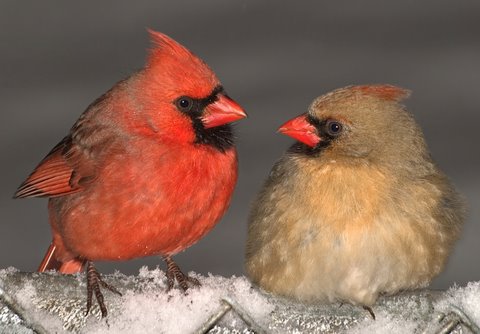
Should I call it a Cardinal, or something else?

Cardinal; juvenile
maybe they're Virginia Redbirds?


We all know what a Cardinal is...or do we?? The Texas Ornithological Society, and most birdwatchers, know it as a Northern Cardinal. But many people (understandably) call it a Redbird (forgetting about the females and juveniles). In Virginia it's a Virginia Redbird or Virginia Nightingale. A few birders call it a Cardinal Redbird. They're all right in a way! Many years ago John James Audubon even knew it as a Cardinal Grosbeak. The only universally-correct name is the cumbersome Latin name Cardinalis cardinalis, but that sounds snobbish.


coyote
                           How dangerous is a Coyote...really? According to Audubon Magazine, there has been only one reported coyote-related death in the U.S. That was over 30 years ago! Typically, Coyotes try hard to avoid people, but we're seeing more and more as we expand into their natural range, and Coyotes have less and less territory in which to hunt.

Those are the facts!  I'm not worried, but if I were a rabbit or housecat I would be.
 

Wednesday, December 5, 2012

Why are birds not visiting my yard right now?

It's absolutely normal. It's nothing you've done, or are not doing. In a week or two it'll be totally different.


Chickadee on sumac
Starting around the end of September and continuing right now, plants are setting seed in dozens and dozens of forms.  You see native grasses producing "plumes", acorns and pecans litter landscapes everywhere, and all our native flowers have "gone to seed". This cornucopia of fresh seed is more enticing to wild birds than anything you could buy in a store. It's as fresh as it can get! So this is where the birds are, not at feeders.

When we get a hard freeze in north Texas (and/or ice storm or snowfall) they'll flock to your feeders enthusiastically. It's important to be ready now, since wild birds will need seed instantly, and won't wait around a day or two - they'll just go to somebody else's feeder.

The leaves on the ground also attract birds, insectivores mainly. The dead leaves harbor millions of tiny bugs. Birds pick through them endlessly for food.

In ensuing years you might want to keep birds in your area by planting what I call "birdscape" plants in your yard.  These plants produce seed reliably and in abundance, and provide totally fresh food for birds throughout the fall. The plants are native to this part of Texas, so the very best time to plant them is now (of course you won't see any top-growth until spring, but the roots will be growing like crazy). I'd be glad to send you a list of these plants if you send me your e-mail address.


[Actually, the above is in response to a question I got recently from a friend.  I thought many of you might have the same worry}