Sunday, June 28, 2015

The bird that almost became extinct because of a rumor.


Years ago, there was a fake “bee scare”. Farmers mistakenly thought that the Eastern Kingbird raided the bee hives they kept for pollinating crops, so they nearly killed the birds off.  WRONG!  (And maybe farmers today should maintain their own bee hives. They might be more concerned about the insecticides they use.)
 
Formerly called the “bee martin”, The Kingbird is a summer bird commonly seen from the Rockies east to the Atlantic coast, including north Texas. Both Eastern and Western varieties are seen here.


Where is the Cardinal a “native”?     Here! It’s lived in north Texas, year ‘round, for a long, long time. However the Cardinal (“Northern Cardinal” to purists) has been introduced into several other places. It was introduced into southern California several times, starting in 1880. In 1929-31 it was introduced into the Hawaiian Islands. Also, it was brought into Bermuda “long ago”  (nobody kept records then). It also expanded its range into a few other areas. Now it is a resident, either native or introduced, in pretty much every state in the c0untry.


OWEN YOST, in addition to being a blogger, is a licensed Landscape Architect emeritus who has lived and worked in north Texas for over 30 years. He is the recipient of a Lifetime Achievement Award of the Native Plant Society of Texas, and is a member of the American Society of Landscape Architects (ASLA), International Federation of Landscape Architects, National Wildlife Federation and the Audubon Society. His office is at Yost87@charter.net in Denton.

Wednesday, June 24, 2015

Controlling ants safely.


The recent huge rains have brought ants out in big numbers, fire ants and many other species. Ants can bother people, but very few species do any real damage. Fire ants are just one of well over a hundred ant species - most of which do no harm at all, but benefit the environment.  Here are some general guidelines on ant control.

1. Identify, as best you can, what ant species you are dealing with. And whether their presence is temporary or permanent, harmful or not. Each species has different habits, and locating their food, water and shelter will determine your success.

2. If the ants are not entering your home, they probably are not doing damage (unless they sting, like fire ants). Watch the activities of the ants to find where they are coming and going. If you find how they are entering your home, you can physically exclude them. If ants stay outside, exclusively, they aid in transforming twigs and leaves into soil, and probably do no harm.

3. Remove or alter the conditions that enticed them in the first place. Keep counters clean of food. Try to keep sinks and surrounding areas dry. Wiping counters down with vinegar or citrus oil can work as a temporary deterrent.

4. If steps 1-3 do not slow the ants down, it is time for baits, dusts or sprays. Remember that you are only seeing a small portion of the colony at any one time. Only about 10% of a colony will forage outside the nest. Therefore baits are often the most effective approach since foraging ants bring it back to the nest. Applying any insecticide organic or chemical could cause the colony to bud or split into multiple colonies creating more problems.

5. Baits, containing boric acid, are highly attractive to ants and under most conditions provide good control. Place baits into spill proof containers out of the reach of children and pets. The stations should be placed along active ant trails. It is important to remember that boric acid contains elemental boron and at high concentrations will sterilize soil, so should not be used in gardens.

6. Ants have a habit of changing food sources from sugars to carbohydrates. It may become necessary to mix peanut butter with boric acid to keep the ants feeding on the boric acid.

7. There are ant baits with the active ingredient abamectin. These baits can provide good control and should be used for heavy infestations or when other bait is not effective. They can be applied in stations around foraging ants or broadcast around ant trails. Again, boric can be damaging to the soil.

8. If the homemade baits fail or if you’re not the “home brew” type, hiring a professional pest control company would be the next step. Be sure to find one that understands the non-toxic approach.


OWEN YOST, in addition to being a blogger, is a licensed Landscape Architect emeritus who has lived and worked in north Texas for over 30 years. He is the recipient of a Lifetime Achievement Award of the Native Plant Society of Texas, and is a member of the American Society of Landscape Architects (ASLA), International Federation of Landscape Architects, National Wildlife Federation and the Audubon Society. His office is at Yost87@charter.net in Denton.

Sunday, June 21, 2015

Have pity!! They need to eat in the summer too


Downy Woodpecker


Hairy Woodpecker
Almost all woodpeckers are here in north Texas all year long – winter and summer. In a pinch they’ll eat things you put out for other birds – like sunflower seeds. However, they much prefer peanuts and suet…all year long. Look for a kind of suet that won’t melt in the Texas sun (unless it gets above about 110°). Or you can make a crunchy peanut butter sandwich for them; it fits perfectly in most suet feeders. Of course, insects in the bark of unhealthy trees is a favorite natural food.  Doing nothing during warm months is problematic, because a hungry woodpecker isn’t a pretty sight.


Discouraging Pigeons.    To discourage Pigeons (more accurately, “Rock Doves”), avoid feeding on the ground or on large tray feeders (a few may still be able to get onto some hopper feeders, but not many). The worst thing is to simply dump birdseed on the ground. This attracts them, along with pesky House Sparrows and rats. The very best plan is to increase the number of trees and shrubs, since Pigeons don’t fly well and prefer to be in open areas like parking lots and big lawns.


OWEN YOST, in addition to being a blogger, is a licensed Landscape Architect emeritus who has lived and worked in north Texas for over 30 years. He is the recipient of a Lifetime Achievement Award of the Native Plant Society of Texas, and is a member of the American Society of Landscape Architects (ASLA), International Federation of Landscape Architects, National Wildlife Federation and the Audubon Society. His office is at Yost87@charter.net in Denton,.

Wednesday, June 17, 2015

Not just short-sighted and outrageous, it's incredibly stupid. Write your sernator.


Barn Swallow

The Migratory Bird Treaty Act of 1918 (MBTA), is under attack by your representatives in Congress. The House put a provision in an unrelated bill that bans the Dept. of Justice from enforcing this “cornerstone” environmental law. If passed by the Senate it could become law.

The federal law was first enacted in 1916 for the protection of birds between the U.S. and Great 
Painted Bunting
Britain (acting, at the time, on behalf of Canada). It recognizes the obvious – birds don’t recognize international boundaries. The act makes it unlawful without a waiver to hunt, pursue, capture, kill or sell birds native to the country. The statute does not discriminate between live or dead birds and also grants protection to bird parts including feathers, eggs and nests. Over 800 species are currently protected. However, the law came too late for some species who became extinct (or whose numbers were greatly reduced) before the law. (pictured are a few of the thousands of bird species that could meet the same fate.)


Northern Cardinals
The U.S. Fish and Wildlife Service issues permits for otherwise prohibited activities. These include taxidermy, falconry, propagation, scientific and educational use, and depredation, an example of the latter being the killing of geese near an airport, where they pose a danger to aircraft.

The Act was enacted in an era when many bird species were threatened by the commercial trade in birds and bird feathers. The Act was one of the first federal 

 environmental laws.  Since 1918, similar conventions between the United States and other nations have been incorporated into the MBTA: Mexico entered into agreement in 1936, Japan in 1972 and Russia in 1976. Some of these agreements protect not only the birds themselves, but also habitats and environs necessary for the birds’ survival.
Hummingbird


Orchard Oriole
This 1918 law demonstrates the federal treaty-making power and the Constitutional ability of federal treaties to override state law.


Yellow-bellied Sapsucker


OWEN YOST, in addition to being a blogger, is a licensed Landscape Architect emeritus who has lived and worked in north Texas for over 30 years. He is the recipient of a Lifetime Achievement Award of the Native Plant Society of Texas, and is a member of the American Society of Landscape Architects (ASLA), International Federation of Landscape Architects, National Wildlife Federation and the Audubon Society. His office is at Yost87@charter.net in Denton.

Sunday, June 14, 2015

Ice cubes: not just for putting in drinks anymore


If a bird chooses to make a nest in your hanging basket, how do you water it? Try ice cubes, carefully placed so as not to crush any eggs.  As they melt, the basket gets watered, and no birds are harmed.


“it just won’t stick there”      If wasps are trying to build a nest inside or on the bottom of a birdhouse, try this: rub a thin layer of petroleum jelly (or rub a dry bar of soap) where they want to attach a hive. The frustrated wasps eventually leave.


OWEN YOST, in addition to being a blogger, is a licensed Landscape Architect emeritus who has lived and worked in north Texas for over 30 years. He is the recipient of a Lifetime Achievement Award of the Native Plant Society of Texas, and is a member of the American Society of Landscape Architects (ASLA), International Federation of Landscape Architects, National Wildlife Federation and the Audubon Society. His office is at Yost87@charter.net in Denton.

Wednesday, June 10, 2015

...Birds like a lawn that’s cut high in the heat


Cattle Egret
During our extremely hot, sunny weather, birds appreciate a lawn that’s mowed high (about 3” or more). It keeps the soil healthier and cooler. Birds can find a little extra safe cover and more food. To paraphrase a friend, when Robins pull worms from the ground, they won’t need pot-holders.

As a licensed Landscape Architect I can also recommend mowing lawns high because the grass will be healthier.  Reason: all those tall grass blades shade the new growth and shade the soil - slowing evaporation; and making you water the lawn less and cooling the roots of the grass plants so they grow better.


OWEN YOST, in addition to being a blogger, is a licensed Landscape Architect emeritus who has lived and worked in north Texas for over 30 years. He is the recipient of a Lifetime Achievement Award of the Native Plant Society of Texas, and is a member of the American Society of Landscape Architects (ASLA), International Federation of Landscape Architects, National Wildlife Federation and the Audubon Society. His office is at Yost87@charter.net in Denton.

Sunday, June 7, 2015

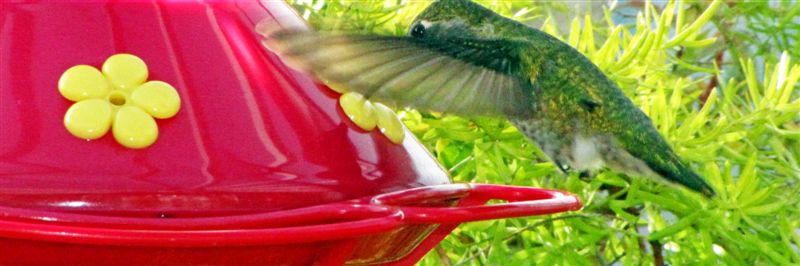
After natural flower nectar, what's the best nectar for Hummingbirds?


Hummingbirds and butterflies love nectar. However, food coloring (red or any other color) has never, in all of time, been proven to be effective. In fact it’s often genetically harmful here. On hot days, it probably will introduce some tiny bits of mold or bacteria, which will rapidly multiply in our Texas heat and pollute your whole batch of nectar, causing Hummers to go elsewhere for food.


       All flowers produce sugary nectar, naturally. But not all flower species have the same ratio of water to sugar. Some flower nectar is strong (2:1 possibly) and some is weak (6, 7 or 8 to 1). I recommend an average of 4:1 (4 parts water to 1 part sugar). CLEAR! No food coloring or vitamins!  That’s  just mythology or ad claims! 4:1 is the ratio that’s been shown to attract north Texas’ Hummingbirds best, both adults and juveniles.

 
Fast Hummingbirds!      As a Hummingbird speeds downward it’s flying, every second, almost 400 times the length of its body. To slow down, it spreads its wings like flaps on an airplane. At that moment its body is “pulling 10 Gs” - equivalent to ten times the gravitational pull of the earth (this is actually deceleration).

Fighter pilots can pass out above 7Gs since their blood gets unevenly distributed in the circulatory system. Hummingbird’s small size, however, prevents this.


OWEN YOST, in addition to being a blogger, is a licensed Landscape Architect emeritus who has lived and worked in north Texas for over 30 years. He is the recipient of a Lifetime Achievement Award of the Native Plant Society of Texas, and is a member of the American Society of Landscape Architects (ASLA), International Federation of Landscape Architects, National Wildlife Federation and the Audubon Society. His office is at Yost87@charter.net in Denton.