Wednesday, November 6, 2013

"cleaning up" your yard scares away birds and encourages weeds


     At this time of year, many homeowners clean up withered plants and fallen leaves out of habit. This habit sells a lot of rakes and plastic bags unnecessarily! Years ago I admit I did it too, just because I saw my neighbors doing it.
        Boy was I wrong!  A knowledgeable friend of mine advised me that bare, exposed ground actually encourages the growth of unwanted plants – “weeds”.  This plant growth is nature's way of holding bare soil in place. Dead plant debris, left on the ground, becomes an organic humus, resulting in looser soil and gives your soil an ability to hold more water and nutrients. So your "wanted" plants grow bigger and better. You can rake up the debris and buy humus in bags every year, or let it develop naturally for free. It’s your choice.

Normal plant debris also adds nutrients to the soil as it decomposes. So, again, you can buy fertilizer in bags every year, or add it to your soil naturally. Normal plant debris also acts like a mulch. Since sunlight can’t reach the unwanted weed seeds, weeds don’t grow. Also, any additional seeds (usually blown in by wind, or dropped by birds) have difficulty reaching the soil, so they can’t get a foothold. Water doesn’t evaporate from the soil as fast, either. So your water bill should be lower.
        Please keep in mind that I’m talking about a “normal” amount of plant debris and leaves. If they pile up by an outside wall or on a sidewalk, by all means clean up.   For years, what I’ve done successfully is shred excess plant debris into tiny pieces (with a lawn mower), and put it right back on the landscape.

        An amazing array of birds, butterflies and small animals live in plant debris. Insects do too! Often these ”beneficial” insects control things like borers, aphids, mosquitoes and termites. Insects also serve as food (remember the food chain?) for the aforementioned birds as well as encouraging frequent visits by migrating species. Rake up the plant debris and insects - followed quickly by birds - go elsewhere.

A word of advice:  be sensitive to your neighbors’ preferences. Take some time to explain to them why your landscape is “natural”, not manicured. Even if they don’t agree with you they should know that you have a long-term plan, and your landscape shouldn’t be blamed on laziness or neglect. It’s very ecology-minded too. The National Wildlife Federation certifies “backyard habitats” and supplies a yard sign to help you provide information.
          You may not be comfortable with leaving plant debris on your entire yard. Instead, do a little at a time. This year, for instance just leave one flower bed “messy”. I’ll bet the soil there will be richer, will require less water and your plants will be healthier and bigger next year. Then the following fall “naturalize” a little larger area;  keep taking it one step at a time.

Most visibly, you’ll have fewer unwanted weeds by leaving plant debris (mainly fallen leaves) where it falls. A once-over with a lawn mower shreds debris into small, fast-decomposing pieces. The results certainly justify what appears be laziness.


OWEN YOST, in addition to being a blogger, is a licensed Landscape Architect emeritus who has lived and worked in north Texas for over 30 years. He is the recipient of a Lifetime Achievement Award of the Native Plant Society of Texas, and is a member of the American Society of Landscape Architects (ASLA), International Federation of Landscape Architects, National Wildlife Federation and the Audubon Society. His office is at Yost87@charter.net in Denton.


Saturday, November 2, 2013

Have lots of baby birds around your house next spring

Birdwatcher’s Digest reports that increased
 
 
supplemental feeding (birdfeeders) during the winter leads to greater nesting success (more baby birds) the following spring. Just make sure you use FRESH seed, not the junk sold in big box stores and such.
 
It's also helpful to have evergreen plants around (for shelter)and filled birdbaths (so birds can keep clean - necessary to staying warm) in bad weather.


Why there is no such thing as a “weed”.   We think we know what a “weed” is but do we really? To most of us, it’s a plant that’s growing in a location we don’t want it to grow. By that definition, the term persists. (I offer the example that a crape myrtle growing in your driveway is a “weed”.) That’s an arbitrary, imprecise definition, but it’ll do for now.

There are precise, horticultural definitions of “tree”, “shrub”, “flower”, “grass” and so on. But there’s no defition for “weed” because it usually depends on one’s feelings and individual tastes – highly variable stuff.

A plant’s “uselessness” also depends on who’s doing the talking and defining. Blackberries for example. The berries taste good and provide food for a great number of birds (Robins, Brown Thrashers, Bluebirds, to name just a few), and many species nest in blackberry brambles (Cardinals, Field Sparrows, Yellowthroats are some). But the thorns can tear up clothing, and cause humans pain. Are they weeds?

An extreme example is poison ivy. Lots of birds like its waxy white berries. Birds, not being allergic to it, flit among the leaves and branches unconcerned. So it may be a “weed” growing near your house, but not when growing in the “back 40”


OWEN YOST, in addition to being a blogger, is a licensed Landscape Architect emeritus who has lived and worked in north Texas for over 30 years. He is the recipient of a Lifetime Achievement Award of the Native Plant Society of Texas, and is a member of the American Society of Landscape Architects (ASLA), International Federation of Landscape Architects, National Wildlife Federation and the Audubon Society. His office is at Yost87@charter.net in Denton.

Wednesday, October 30, 2013

Why is feeding birds such a popular, year-'round hobby?


Suet feeder
 
Thistle feeder
 

Window/tray feeder

Lots of people feed birds in north Texas – it’s one of the biggest hobbies there is, for Texans of any age. But WHY do it at all?  And, what does it take for someone to get started?

First let me say that there are no rules and procedures. None! There is no club to join (unless you want to), there’s no “must” wearing apparel, and you don’t have to travel anywhere (again, unless you want to). Getting started is as simple as hanging a birdfeeder in your yard, and filling it with fresh seed that north Texas birds like. You can do it every month of the year. Your interest will probably build exponentially from there.

You don’t even have to buy a birdfeeder. You could merely put fresh seed on a plate on the ground if you like (it works, but has drawbacks). Or you could just put a peanut butter sandwich in the fork of a tree (remember; there are no rules). Of course, there are extra things you might do to make your yard its most attractive to birds.

If you were to ask someone why they feed birds, he or she’d hem and haw a bit before answering something like “it’s fun”. It just makes you feel good – you instantly become part of nature when you put out a birdfeeder. You feel an indescribable emotion when you see a flash of color from your window, or watch an unusual species feast on food you gave them.

A few avid birdwatchers have a way of making the rest of us feel insignificant.  It doesn’t matter, however, if the bird you’re seeing is a Northern Harrier, a Lesser Goldfinch or an Indigo Bunting. That may or may not come later. All you really need to know now is that there are several very good reasons to start feeding birds.

  • Feeding birds is something you can do year-'round. Any time of year is the best time; birds are always hungry. And there are always birds around -'though the species may differ seasonally.
  • It’s inexpensive. Very few hobbies are as inexpensive as feeding birds. Part of the reason is that it’s done in your own yard – no travel required.
  • It’s calming and relaxing. Few things are more blissful than looking out your window at several carefree birds on your feeder, knowing that you’re responsible for their food.
  • It’s educational. Seeing things like courting rituals, eggs hatching, “pecking order” at feeders, fledglings being taught where to eat etc. is profoundly instructional.
  • It controls bugs. Since most birds eat bugs by the thousands, birds are cheaper and safer by far than whatever chemical you’ve been spraying.
  • It’s physically undemanding. Even if you have difficulty walking (or almost any other disability) you can handle birdwatching.
  • It helps them stay in their habitat. Your house probably sits where some birds used to live - eliminating their food sources and habitat. Mine does! To help set matters straight, we owe it to them.

Getting started doesn’t take much effort at all. Just put out a birdfeeder (or 2, or 3, or 4), and go back inside. A word of advice: get feeders that are well designed and well-built. Few things are as discouraging as a feeder that falls apart during the first squirrel encounter, or one that doesn’t last through a severe storm. Also, if you have a lot of trees, be certain a new feeder is really squirrel-proof – printing nice words on the box isn’t enough.
hopper feeder
 
squirrel-proof feeder


Fill it, or them, with good-quality, fresh seed (the kinds that north Texas birds like) and just sit back and enjoy. That’s all!


OWEN YOST, in addition to being a blogger, is a licensed Landscape Architect emeritus who has lived and worked in north Texas for over 30 years. He is the recipient of a Lifetime Achievement Award of the Native Plant Society of Texas, and is a member of the American Society of Landscape Architects (ASLA), International Federation of Landscape Architects, National Wildlife Federation and the Audubon Society. His office is at Yost87@charter.net in Denton.
 

Sunday, October 27, 2013

Owls; the best rodent killer there is


Great-horned Owl

  An owl    kills its prey by driving its razor-sharp talons in deeply. The prey (usually a field mouse, rat, snake or squirrel) then dies quickly from a punctured (whatever it is). The pressure a Great-horned Owl or Barred Owl (both seen in north Texas) exerts with its talons is a phenomenal 250 pounds per square inch (“psi”). Compare that to the pressure I (an ordinary male) can squeeze with – around 80 psi.  Maybe 90 if I’ve had a good breakfast.


 However, YOU could kill an owl just by using a poisonous/chemical rodent killer. Many brands of rodent poison aren’t finished when they kill a rodent; any creature that eats the rodent’s carcass (often an owl) is poisoned too. That’s a shame since an owl may kill and eat dozens of pests per day – at no cost or danger to you.


PLANT AHEAD!!            This the very, very best time for planting in north Texas (all but tender flowers).  From late September to about Thanksgiving is the prime time, unlike up north. (Spring planting is a silly custom held over by transplanted northerners) Of course, you won’t see any above-ground growth now, but the roots will be growing like crazy, so in a Texas spring the plant can spring right into action.
 
Red Yucca
The reason is mainly due to frozen earth. Up north the earth can freeze solid to a depth of 3-6 inches (often all winter long), making root growth impossible. Here, however, the earth rarely freezes, even then it's only to about half an inch deep and only for a day or so. So roots here can grow all winter long, and in the spring a plant can literally "burst" forth.


OWEN YOST, in addition to being a blogger, is a licensed Landscape Architect emeritus who has lived and worked in north Texas for over 30 years. He is a recipient of a Lifetime Achievement Award of the Native Plant Society of Texas, and is a member of the American Society of Landscape Architects (ASLA), International Federation of Landscape Architects, National Wildlife Federation and the Audubon Society. His office is at Yost87@charter.net in Denton.

Wednesday, October 23, 2013

Yours truly gets lifetime achievement award

From birth, most people are taught not to be boastful, immodest or pompous. I'm going to break that rule right now because this is MY blog, and I'm not beholden to any company policy, outdated manners or any advertisers (that's my choice and intent). So I can write my opinions about whatever I see fit. If you think otherwise, email me with the subject line "Put in Trash".


This past Saturday, I was honored to receive a lifetime achievement award at a banquet in Corpus Christi.  It was for my work involving native Texas plants, presented by the Native Plant Society of Texas. Thank you very much!

NPSOT (as it's called - pronounced just like it's spelled) was founded in 1981 in Denton TX, and now has 34 chapters throughout the state. They've taken on the monumentally ambitious task of making Texas landscapes compatible with our unique environments. The method is to dramatise the many native plants of Texas, and that they, over the ages, got used to our heat, drought and poor soil. Therefore, they'll survive here!

The native plants, used in place of exotics, always fare better than the typical exotic plants from Japan, California, Italy or some other far-off land. Usually requiring much less maintenance too. The finicky exotics often end up in a dumpster.

My landscape design work, always including native plants, encompasses commercial and institutional work, as well as residential projects throughout Texas. In addition, the award is for extensive writing - over 200 articles plus this blog.

Great Blue Heron
But enough about me.  The following day we went to Padre Island and saw lots of Pelicans (whose beaks can really hold more than their belly can), tons of water birds, and a few Great Blue Herons (pictured).


Monday, October 21, 2013

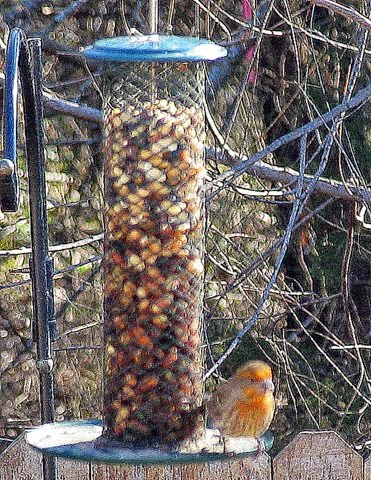
House Finches live among us


House Finch
Personally, I like House Finches. Their songs are pleasant, they’re very comfortable around humans, and can be very colorful. However, some people have large throngs of House Finch visitors, and some more desirable species may get crowded out.

The gregarious House Finches are terrible “clingers” so try this; Try removing the perches from your tube feeders. Most tube feeders allow you to do this, and it has minimal effect on clinging birds (such as Chickadees and Titmice) - who usually just cling to the edge of the “port” (or opening) instead. There are a few seed feeders on the market, such as a globe feeder, with no perches. These can keep most House Finches from your seed for a while, but my advice to live with them, and enjoy them.

Some people confuse them with Cardinals, because the head and breast can be so red on the males. This comes from pigment in their food. In fact the female selects a mate depending on its redness, rightly assuming that a bright red male is a better food finder and can feed youngsters better.

House Finch
They used to be found only in far west U.S. and in Mexico. But they’ve expanded to cover the entire country. Believe it or not, the Great Plains (which includes north Texas) has the least House Finches; though your neighbor who gets hundreds may not concur.

Also, House Finches are one of the few species that can feed seeds (like from a feeder) to their young. So a House Finch at your feeder may be eating for two, or three, or four or…

A non-stop flight that wasn’t delayed


The record for non-stop bird migration has been set by a Bar-tailed Godwit (you won’t see one around here). The shorebird flew from New Zealand’s North Island to Yalu Jiang, at the northern end of China’s Yellow Sea, a distance of 6,200 miles, in nine days.  There was no tailwind and no stopping (the route was mostly over water anyway). The numbers are precise since the Godwit was equipped with a satellite transmitter.


 OWEN YOST, in addition to being a blogger, is a licensed Landscape Architect emeritus who has lived and worked in north Texas for over 30 years. He is a member of the American Society of Landscape Architects (ASLA), International Federation of Landscape Architects, National Wildlife Federation and the Audubon Society. His office is at Yost87@charter.net in Denton.

Wednesday, October 16, 2013

Quite a few "urban birds" call north Texas home. Recognise any?


Common Grackles

Carolina Wrens


There are more birds living in and around the cities than you may think. I'm constantly amazed at how adaptable some birds are - finding food and a bit of habitat in the most unlikely places. These are the most numerous urban birds in this area..

American Robin Actually lives here year-‘round

House Finch Sometimes called a red-headed “Hollywood Finch”

Red-winged Blackbird Travels and feeds in large flocks

American Crow Extremely intelligent, for a bird

European Starling Imported from Europe around 1905

House Sparrow Not a true North American sparrow

Dove Several species, all with memorable songs

Killdeer Likes to nest near pavement

Rock Pigeon Well-adapted to city life

Carolina Chickadee Small, inquisitive bird

Tufted Titmouse Takes readily to birdhouses

Grackle Their range is expanding northward

Wren Several species of this active, loud bird

Northern Mockingbird Our official state bird

Blue Jay Large bird that loves peanuts

 
White-winged Doves


Carolina Chickadee
American Robin

Blue Jays


Killdeer